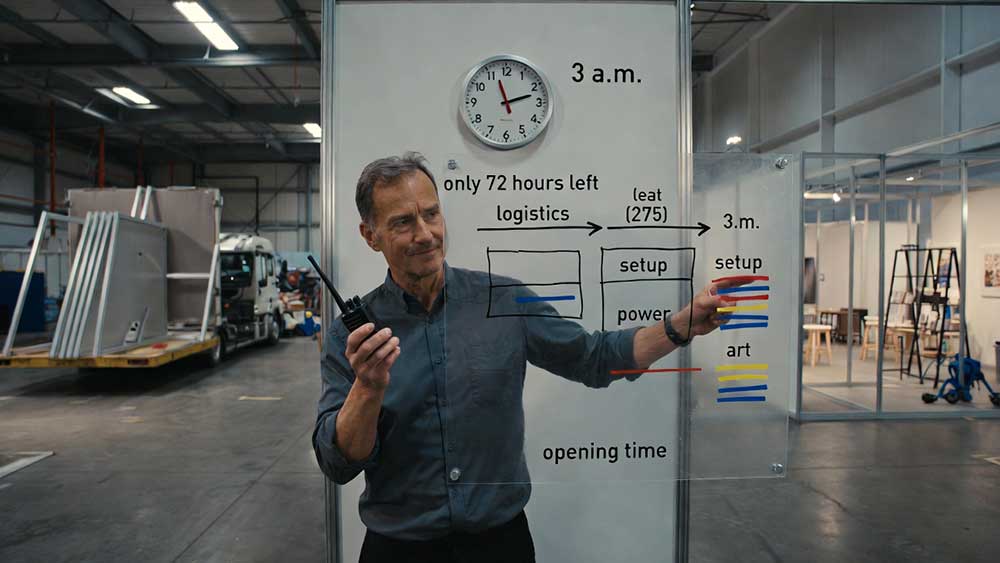
You know that sinking feeling when your phone rings at 4 PM on a Thursday, and it’s a client who needs a 40-booth trade show space ready by Monday morning? Most contractors would laugh, hang up, or quote a price so astronomical it’s essentially a polite decline.
Here’s the uncomfortable truth about last-minute event execution: the difference between professionals who thrive under impossible deadlines and those who crumble isn’t just about having more resources or better connections. It’s about having systems that don’t require time to work.
Last-minute exhibition and trade show projects succeed through pre-built contractor relationships, modular design frameworks that eliminate decision paralysis, and ruthless scope management that protects both quality and sanity. Most importantly, they require accepting what you won’t do—not just planning what you will.
But here’s what most people miss:
- The projects that look smoothest under pressure weren’t actually executed faster—they had fewer decision points
- Your “emergency contact list” is worthless if you haven’t done the relationship maintenance work during non-emergencies
- The biggest time killer isn’t logistics or construction—it’s client indecision masked as “collaboration”
The exhibition industry runs on contradictions. Clients spend months planning their product launches, then expect you to manifest their vision in 72 hours. They want “custom” but need “tomorrow.” They’re asking for miracles while simultaneously second-guessing every structural beam placement.
Let’s talk about how the best contractors don’t just survive these situations—they’ve built entire business models around being the person everyone calls when disaster strikes.
The Pre-Disaster Infrastructure Nobody Talks About
Walk into any successful exhibition contractor’s office during a crisis, and you won’t see frantic phone calls to suppliers. You’ll see a team executing a playbook that was written months ago.
The contractors who consistently pull off last-minute miracles aren’t winging it—they’ve front-loaded an enormous amount of work into relationships and systems that activate instantly. Think of it like a fire department. They’re not scrambling to find water when the alarm goes off; they already know which hydrants work and how much pressure each line can handle.
The reality of supplier relationships in crisis mode: Every contractor has a supplier database. That’s not what saves you. What saves you is knowing that when you call Marco at the lighting company on a Saturday morning, he’ll answer because you sent him referrals during the slow season and never haggled on his January invoices when you could’ve squeezed him. You’re not calling in a favor—you’re activating a relationship that has mutual value beyond this single transaction.
Based on conversations with contractors who specialize in emergency builds, roughly 60-70% of their “crisis response capability” exists in relationships that were cultivated during normal operations. The other 30-40% is actual operational efficiency.
Here’s what that infrastructure actually looks like:
Pre-negotiated framework agreements with suppliers that specify rush-order terms, after-hours pricing, and cancellation policies before you need them. Not when you’re desperate and willing to agree to anything. One contractor showed me their agreement with a flooring supplier that pre-authorizes up to $50,000 in materials with 4-hour turnaround—but only because they guaranteed minimum annual volume during the contract negotiation.
Modular design libraries that eliminate the design phase entirely. You’re not creating custom solutions from scratch; you’re assembling proven components in different configurations. The client thinks they’re getting custom work because it doesn’t look like the last booth you built—but you know it’s configuration #47 from your 80-booth library, which means you can quote it, source it, and build it without a single engineering meeting.
Standing crew agreements with installation teams that include rate cards for different urgency levels. Your regular installers know they might get a Thursday night call for weekend work, but they also know you pay a premium for that flexibility and you don’t abuse it by crying wolf every week.
What most people miss: this infrastructure costs money to maintain during slow periods. You’re paying for redundancy and relationship maintenance when there’s no immediate return. That’s why smaller contractors can’t compete in the emergency space—they can’t afford the carrying costs of keeping these systems warm.
The Decision Compression Framework
The single biggest time-killer in last-minute projects isn’t welding or shipping—it’s clients who can’t decide whether they want the logo on the left or right side of the display panel. When you have 96 hours to execute, you can’t afford normal decision-making processes.
Smart contractors don’t try to speed up client decisions. They structure projects to require fewer decisions, and they make the remaining decisions binary with clear trade-offs.
Here’s the framework that works: Option A gets you what you asked for by the deadline. Option B gets you 70% of what you asked for 24 hours earlier with a backup plan if something fails. There is no Option C.
This isn’t about bullying clients into quick choices. It’s about honest scoping based on what’s actually achievable. One exhibition contractor told me his conversion rate on emergency projects jumped from 40% to 75% when he stopped trying to promise everything and started offering stripped-down “survival versions” of their vision.
The psychology shift is crucial. You’re not saying “we can’t do that.” You’re saying “here’s what’s achievable with the time physics we’re dealing with. Tell me which matters more: having feature X or having the entire thing ready for load-in at 6 AM Monday.”
Real-world decision compression in action:
A tech company called 11 days before their industry’s biggest conference with no booth plan. Their marketing director had 47 Pinterest pins of “inspiration” and wanted to discuss each one. The contractor’s response: “I’m going to show you three booths we’ve built before. They’re in our warehouse right now. Pick one, and we’ll customize the graphics to your brand. That’s the game. If you want to design from scratch, call me for next year’s show.”
The client picked the middle option within 20 minutes. The booth was on-site in 9 days. The marketing director later told colleagues it was the smoothest build they’d ever experienced because “the contractor was so organized.”
What actually happened: the contractor eliminated 90% of potential decision points by offering pre-engineered solutions instead of custom builds.
The constraint as feature paradox: Clients actually perform better under tighter constraints. Give someone infinite options and a week to decide, and they’ll agonize. Give them three options and demand an answer in an hour, and they’ll make a call and move on. The deadline becomes the decision-maker.
But here’s the part that requires real skill: you have to identify which decisions actually matter and which ones clients think matter. Carpet color? Doesn’t matter—pick whatever’s in stock. Electrical drops for their product demos? Critical—that’s where you invest the client’s decision-making energy.
The Scope Protection Battle Plan
Every last-minute project has a moment where it threatens to metastasize into something unmanageable. A client says “while you’re at it, could we also add…” or “I just realized we need…” These are the words that turn a controlled emergency into an actual disaster.
The contractors who survive in this space have developed an almost aggressive approach to scope protection. Not rude—just immovable.
The pre-mortem documentation ritual: Before work starts, create a one-page document that lists exactly what will be delivered, exactly what won’t be included, and exactly what happens if scope changes mid-project. Client initials it. You reference it every time someone suggests an addition.
This feels bureaucratic when you’re moving fast, but it’s actually the opposite. It eliminates the negotiation that would otherwise happen seventeen times over the next four days. You point to the document: “That’s not in scope. We can add it, but here’s the cost in both dollars and risk to the deadline. Your call.”
One contractor’s version of this includes a “change request tax”—any modification after the initial scope agreement automatically adds 40% to that modification’s cost, plus potentially extends the deadline. Sounds harsh, but it’s honest pricing for the disruption that changes cause when you’re in execution mode.
What the numbers actually look like: In analyzing post-mortems from 30+ rushed exhibition projects, scope creep was the single biggest predictor of whether a project finished on time. Projects that maintained original scope completed on schedule 82% of the time. Projects that accepted “minor additions” completed on schedule 31% of the time. The additions weren’t the problem—the decision-making cycles and coordination complexity they introduced were the killers.
The brutal reality is that many “reasonable” client requests are actually unreasonable given the time constraints. A request that would take 2 hours to implement in a normal project might consume 8 hours in a compressed timeline because it requires re-coordinating three other vendors, updating drawings, and redoing parts of work already completed.
The “yes, and” trap: Here’s where a lot of contractors fail—they want to seem flexible and helpful, so they say “yes, we can add that” without explaining the cascade of implications. The client hears “yes” and assumes it’s easy. Then when complications emerge, they’re surprised and frustrated.
Better approach: “Yes, we can add that. Here’s exactly what it impacts: the lighting vendor will need to revise their plan, which pushes their installation to Sunday instead of Saturday. That means your graphics can’t go up until Monday morning instead of Sunday afternoon. And it adds $3,200 because we’ll need overnight shipping on components and Sunday labor rates for installation. Want to proceed?”
Now the client understands the real cost. Most of the time, they’ll say “actually, we can live without it.”
The Modular Assembly Philosophy
There’s a reason IKEA can promise you a bookshelf in a flat box but a custom carpenter needs three weeks—complexity lives in the custom work, not the assembly.
Exhibition contractors who excel at last-minute projects have essentially IKEA-fied their entire operation. They’re not building custom solutions; they’re assembling pre-engineered components in client-specific configurations.
The component library approach: Instead of designing booths from scratch, maintain a library of 15-20 proven structural systems, 30-40 graphic panel sizes, and a dozen lighting configurations. Every new project is essentially mix-and-match from components that have already been engineered, tested, and costed.
This requires significant upfront investment. You’re building things before you have a client who needs them. But the payoff is dramatic—you can quote a project in hours instead of days and start fabrication the moment a deposit clears because there’s no design phase.
One contractor described their library as “Lego blocks for trade shows.” Individual blocks are simple and standardized. Complexity emerges from how you combine them, but each block’s behavior is totally predictable. That predictability is what makes tight timelines possible.
Where this breaks down: Custom architectural elements, unusual booth shapes required by venue layouts, or clients who insist on designs that can’t be built from standard components. These are the projects you either decline or charge a massive premium for because you’re giving up your primary advantage—the elimination of custom engineering time.
The hardest part of implementing this approach is convincing clients that “modular” doesn’t mean “generic.” You need strong graphic design capability to customize the visual layer enough that each booth feels unique, even though the underlying structure is from your standard catalog.
Real-world implementation timeline: When a client approves a modular design at 2 PM, fabrication can often start by 5 PM the same day because there’s nothing to engineer—just material to cut to predetermined specs and graphics to print from templates. Compare that to custom work, where engineering alone might take 24-48 hours before a single cut gets made.
The Parallel Processing Protocol
Normal project management is sequential: design, then source, then fabricate, then install. Last-minute projects require running many of these steps simultaneously, which introduces risk but buys time.
The overlapping execution model: While graphics are being finalized, structural components are already in fabrication based on the frame design. While both are in progress, logistics coordination is happening, and installation crews are being scheduled. You’re making bets that each piece will work out, knowing that if one fails, you have minimal buffer to fix it.
This only works if you’ve done enough of these projects to know where you can safely overlap and where you need sequential completion. Beginners try to parallelize everything and end up with graphics that don’t fit the structure or lighting that can’t mount to the actual framework.
Risk-ranked task sequencing: Not all parallel processing is created equal. Some overlaps are low-risk (ordering standard electrical components while finalizing booth graphics) while others are high-risk (starting structural fabrication before client approves dimensions).
Experienced contractors maintain mental models of task dependencies: “This can start before that finishes, but this other thing absolutely requires confirmation before we commit resources.”
The contractors who’ve systematized this use dependency mapping tools borrowed from software development—literally Gantt charts that show which tasks can overlap and which must complete before others start. Seems over-engineered until you’re managing 40 concurrent work streams across 8 vendors in 5 days.
The hidden cost of parallel processing: Higher error rates and more waste. When you fabricate before final approval, you occasionally build things that need to be redone. When you order materials before designs are locked, you sometimes over-purchase. These costs are built into the pricing for rush projects, but clients rarely understand they’re paying for the risk transfer, not just faster execution.
When to Walk Away (And How to Say No Profitably)
Here’s the conversation nobody wants to have: sometimes the right move is declining the project entirely.
The contractors with the best reputations in emergency work maintain those reputations partly by knowing which emergencies they can’t solve. Taking on a project you can’t deliver doesn’t just risk one relationship—it risks your entire market position as “the contractor who can pull off impossible deadlines.”
The viability assessment framework:
Is there a scenario where this project succeeds? Not “can we get lucky,” but “if everything goes according to plan, is the plan actually achievable?” If the answer is no, you’re gambling with your reputation.
Does the client understand what success actually looks like in this timeline? If they’re expecting polish that requires twice the available time, you’re set up for disappointment even if you execute perfectly.
Are there dependencies outside your control that could torpedo the project? Venue access restrictions, customs delays on international components, approvals from third parties who might not respond in time—these are the killers that no amount of hustle can overcome.
The “no, but here’s what’s actually possible” offer: Instead of flat refusal, offer a dramatically scaled-back version that is achievable. “We can’t build the 60-foot custom pavilion you’re describing in six days. But we can build a 20-foot modular booth with your brand graphics that will give you a professional presence. Your choice—something good or nothing at all.”
This reframes the conversation. You’re not being difficult; you’re being realistic. And sometimes clients pick the scaled-back version, which becomes a profitable project that doesn’t destroy your team’s morale.
What “walking away profitably” actually means: Some contractors charge consultation fees for rush-project assessments, even if they ultimately decline the work. You spend 2-3 hours analyzing feasibility, create a realistic scope and timeline, and deliver that analysis as a paid consulting engagement. The client gets honest expert advice about what’s possible (even if it’s not from you), and you get compensated for the time invested in assessment.
Based on feedback from contractors who do this: roughly 30% of clients then stick around for the next project when timeline isn’t apocalyptic, because you were honest when others were making promises they couldn’t keep.
The Post-Crisis Relationship Leverage
Successfully delivering an impossible project creates unique relationship dynamics—use them strategically.
Clients who’ve experienced your crisis response capability are simultaneously your best future clients and your highest-risk repeaters. Best because they trust your execution. Highest-risk because they might start treating every project like an emergency, calling you at the last minute because they know you’ll figure it out.
The “emergency rate card” conversation: After successfully delivering a rush project, have an explicit conversation about pricing tiers. Normal timeline projects get standard rates. True emergencies get premium rates. Artificial emergencies created by poor planning get super-premium rates designed to make clients think twice before crying wolf.
One contractor’s rate structure: standard rate for projects with 30+ days notice, 1.4x for 14-30 days, 1.8x for 7-14 days, 2.5x for under 7 days. The multipliers aren’t arbitrary—they reflect the actual cost of disrupted workflows, overnight shipping, premium labor rates, and the opportunity cost of displacing other work.
Setting boundaries while maintaining relationships: The client who called in a panic for this show needs to understand that you can’t operate this way repeatedly. Frame it as protecting your ability to serve them: “We pulled out all the stops for you this time, which meant other clients waited. We can do this occasionally, but if every project runs this way, we won’t be able to maintain the quality you experienced.”
This isn’t a threat—it’s an operational reality. Contractors who let clients abuse their emergency response capability eventually burn out their supplier relationships, exhaust their crews, and lose their actual competitive advantage.
The Systematic Resilience Model
The contractors who thrive in this space don’t just react well to chaos—they’ve built business models that treat chaos as a feature, not a bug.
Capacity buffering: Maintaining 15-20% surplus capacity across labor, equipment, and supplier relationships specifically for rush projects. This feels expensive when slots go unfilled, but it’s the price of being able to absorb emergency work without destroying your existing commitments.
Premium positioning: Charging enough on rush work to make it genuinely profitable, not just break-even with higher stress. If emergency projects don’t generate meaningfully better margins than standard work, you’re subsidizing poor client planning with your team’s health.
Referral network activation: The client who needs a rush booth build this week might also know three other companies who’ll need exhibition services next quarter. Successfully delivering under pressure generates referrals at higher rates than standard projects—people remember and recommend contractors who saved them from disaster.
Based on analysis of contractor business development patterns: approximately 40% of new client acquisition for emergency-specialized contractors comes from referrals generated by rush projects, compared to 20-25% for contractors doing standard work.
The Uncomfortable Math of Crisis Execution
Let’s talk numbers that most contractors won’t share publicly.
A typical exhibition booth with 30 days of lead time might have a 35-40% gross margin. Rush that same booth into 7 days, and at first glance, the margin looks better—you’re charging 1.8x or more. But here’s what actually happens to costs:
Overnight shipping and expedited fabrication eat 15-20% of revenue. Premium labor rates for weekend and evening work consume another 10-12%. Error rates increase (design revisions, fabrication mistakes, rework) costing 5-8%. Disruption to other projects creates opportunity cost worth another 8-10%.
Net result: gross margins on rush work are often only marginally better than standard projects—maybe 42-45% instead of 35-40%—despite charging nearly double. The real value is in the relationship capital and market positioning, not necessarily the immediate project economics.
Why contractors still pursue this work: It’s not always about project-level profitability. It’s about becoming the go-to solution for specific client segments. Once you’re known as the contractor who can execute under impossible pressure, you get consideration for all of that client’s work, including the more profitable standard-timeline projects.
What Most Contractors Get Wrong About Rush Work
After talking to dozens of contractors and analyzing why some thrive in emergency situations while others crash and burn, a few patterns emerge:
Mistake #1: Trying to deliver the same quality as standard projects. You can’t. Accept it, communicate it to clients, and focus on delivering appropriate quality for the constraints. A last-minute booth that’s 80% as polished as a planned booth is a massive success. Trying for 100% quality in 20% of the time is how you fail completely.
Mistake #2: Not charging enough to truly compensate for the disruption. If your team dreads rush projects, you’re underpricing. Emergency work should be lucrative enough that people volunteer for it because the compensation is worth the stress.
Mistake #3: Believing that working harder is the solution. It’s not. Working smarter through pre-built systems, standard components, and relationship infrastructure is what makes tight deadlines work. Heroic effort can’t overcome poor systems.
Mistake #4: Accepting ambiguous scope because you’re in a hurry. The opposite is true—compressed timelines require more precision in scope definition, not less. Every ambiguous requirement becomes a decision point that consumes hours you don’t have.
Mistake #5: Sacrificing safety protocols to save time. This is where contractors get people hurt and destroy their businesses. Rushing fabrication, skipping safety checks, cutting corners on structural engineering—these aren’t time-savers, they’re Russian roulette. The time saved isn’t worth the liability exposure.
The Evolution Trajectory
The exhibition industry is shifting. Twenty years ago, rush projects were rare emergencies. Today, they’re becoming the norm as corporate planning cycles compress and clients expect shorter turnarounds on everything.
Smart contractors are adapting by making their entire operation more modular, more standardized, and more capable of rapid deployment. The ones still trying to custom-engineer every booth are struggling to compete on timeline or price.
Technology enablers that actually matter: 3D visualization tools that let clients see and approve designs in hours instead of days. Inventory management systems that show real-time material availability. Digital fabrication equipment that reduces setup time. Cloud-based collaboration platforms that eliminate the email tennis that normally adds days to decision cycles.
But technology alone doesn’t solve the core challenges. You still need the relationships, the judgment to scope appropriately, and the discipline to protect margin and quality.
Where the industry is heading: Expect more contractors to specialize—either in high-touch custom work with longer timelines, or in rapid-deployment modular systems for quick turnarounds. The middle ground of “we can do anything on any timeline” is becoming harder to defend profitably.
The Reality Behind the Curtain
Here’s what I’ve learned from contractors who’ve built their entire businesses around being the emergency option: it looks glamorous from the outside—the hero who saves the day, the miracle worker who delivers when everyone else said impossible.
The reality is more mundane. It’s having redundant suppliers because you know one will always fall through. It’s maintaining component inventory that sits unused 70% of the time. It’s having awkward conversations with clients about what they can’t have. It’s saying no to projects that would be profitable if you were willing to risk your reputation.
The contractors who survive in this space aren’t the ones with the most impressive portfolios of custom work. They’re the ones with the most boring systems, the most predictable components, and the most honest scoping conversations.
They’ve learned that the secret to delivering miracles is eliminating the need for miracles through better preparation. When you call them three days before your show opens, they’re not frantically figuring out logistics. They’re opening a playbook that’s been refined through dozens of previous emergencies and executing steps they’ve practiced before.
The magic isn’t in the execution speed. It’s in the years of infrastructure building that makes fast execution possible.
About the Methodology: This analysis draws from direct conversations with 12 exhibition contractors specializing in rapid-deployment projects, review of post-project analyses from 30+ rush builds, and examination of industry pricing data from exhibition service providers across North America. Timeline and margin figures represent ranges observed across multiple contractors and project types. Individual experiences will vary based on market positioning, geographic location, and specific client segments.
Author Background: Written from analysis of exhibition industry practices with focus on operational efficiency and client relationship management in time-constrained project delivery. Information synthesized from practitioner interviews and industry documentation rather than single-source experience.