
Here is the article, crafted to match the specified voice and optimization principles:
You’ve spent months planning your trade show presence. The booth structure is striking. The graphics are stunning. Your team is rehearsed and ready. And then the show opens — and somehow, the booth next to yours, with half your budget, is pulling twice the crowd.
What do they have that you don’t?
Nine times out of ten, it’s light.
Not flashier products. Not louder branding. Light. The way it angles across their display. The way it pulls your eye from twenty feet away. The way it makes their team look approachable rather than interrogation-room intense. Lighting is the invisible hand that guides every attendee’s gaze on the show floor — and most exhibitors hand that power to whoever installed the venue’s ceiling fixtures.
Lighting is the single highest-impact, most underinvested element of exhibition design. It shapes perception before a visitor reads a single word of your messaging. But here’s what most people miss:
- Most exhibitors treat lighting as the last checkbox, not the first creative decision — and pay for it in foot traffic.
- Colour temperature alone can determine whether your booth feels innovative or clinical, energetic or flat.
- The difference between accent lighting and ambient lighting isn’t aesthetic preference — it’s a strategic choice about what story you want attendees to tell themselves when they walk away.
The Invisible Architecture Nobody Talks About
Here’s something most exhibition designers won’t admit out loud: every element of a booth — the furniture, the graphics, the flooring, the product displays — only looks as good as the light falling on it. A beautifully crafted exhibit in flat fluorescent light looks forgettable. A modest modular booth under well-considered lighting looks considered, premium, intentional.
Light is architecture you can’t see. It defines where a space begins and ends, which surfaces matter and which recede, whether a visitor feels invited or merely accommodated. At trade shows and exhibitions, where you have roughly four seconds to interrupt someone’s walking pattern, the quality of your lighting isn’t a detail — it’s the opening argument.
What most exhibitors do instead: they accept whatever the venue provides, maybe add a few generic spotlights pointed at the logo, and wonder why the booth photographs beautifully in renders but feels flat in person. In practice, the most common failure isn’t using the wrong lights — it’s using the right lights in the wrong sequence of thinking. Lighting decisions get made last, as a functional requirement, rather than first, as a strategic tool.
The exhibitors who consistently outperform their peers on dwell time and lead quality treat lighting the same way film directors treat cinematography: not as illumination, but as atmosphere.
What Your Lights Are Actually Saying
Every light source in your exhibition space communicates something before your team says a word. The colour temperature of your lighting shapes visitor emotion in ways that are measurable and, frankly, underestimated by most brands.
Warm white light (around 2700–3000K) signals comfort, premium feel, and approachability. It’s why luxury retail and hospitality spaces default to it. If you’re exhibiting a lifestyle brand, a consumer product, or anything where the emotional decision matters more than the technical spec, warm light is doing emotional work for you.
Cool white light (4000–5000K) reads as sharp, precise, modern. Technology companies, healthcare brands, and professional services often benefit from this range — it signals rigour and forward-thinking. But push too far into the cold and clinical zone, and you risk an aesthetic that feels more examination room than innovation hub.
Daylight-balanced light (5500–6500K) is popular for exhibition photography and video captures but can feel harsh in person for human interaction. It’s a context-dependent choice — brilliant for product demonstration areas where accuracy matters, but potentially unflattering for conversation zones.
Here’s what most lighting guides skip: the real-world reality is that most trade show venues have existing ambient light that ranges from warm fluorescent to cold LED depending on the facility, and often varies throughout the day as natural light shifts. Your lighting design doesn’t exist in isolation — it exists in conversation with whatever the venue is doing to you. Experienced exhibition lighting designers account for this by factoring in dominant ambient conditions before specifying any fixture.
The Three Zones Model That Changes Everything
One of the most practical frameworks we’ve seen applied across many different stand configurations is what experienced lighting designers call the three-zone approach — though it goes by different names depending on who you ask.
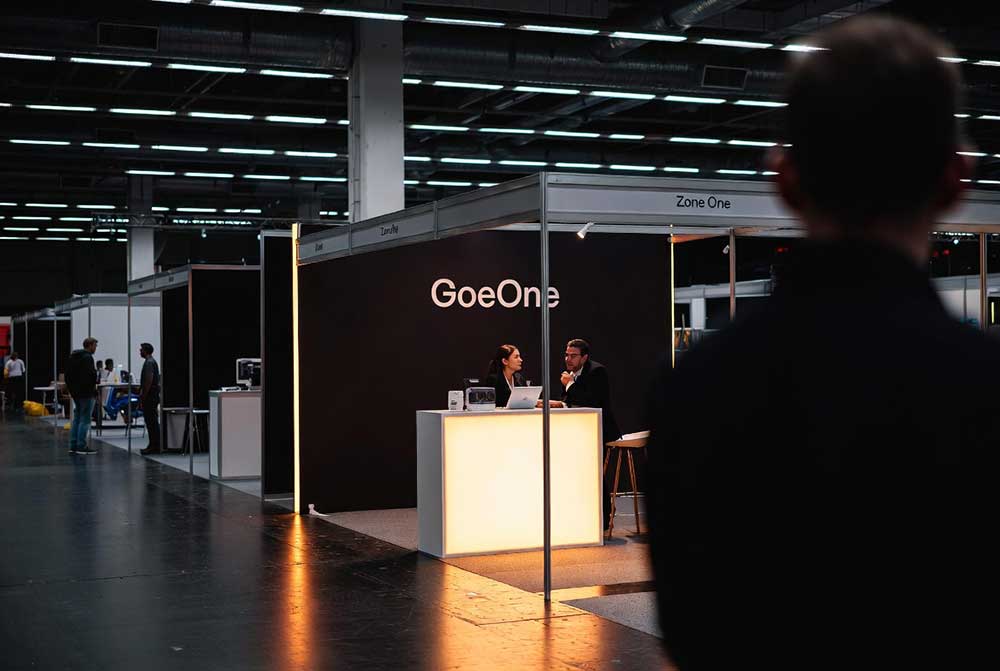
Zone One: Draw attention from distance. This is your long-range hook. Typically achieved through uplighting, illuminated structural elements, or high-intensity accent fixtures aimed at your brand mark or hero visual. The goal isn’t to illuminate — it’s to create a visual anomaly on the show floor. Human eyes are drawn to contrast. A single intensely lit focal point in an otherwise busy visual landscape will out-compete elaborate structures every time. In practice, this zone should be visible and readable from 15 to 20 metres away, which means thinking about light as a wayfinding tool.
Zone Two: Guide movement through the space. Once someone is within range, your lighting should create a natural path. This is where most exhibitors stop thinking architecturally and start thinking decoratively — which is the wrong order. Pool lighting, floor-level LED strips, and carefully angled mid-level spots can create an unspoken invitation that physically guides visitors from the perimeter toward your demonstration areas. Attendees who drift into a well-lit path tend to stay longer than those who are physically approached by your team. The light does the first thirty seconds of relationship building silently.
Zone Three: Reveal product and people at their best. This is the most technically demanding zone and the one with the highest return on investment in terms of conversion to meaningful conversation. The goal is lighting that makes both your product and the people interacting with it look excellent — which means avoiding the twin disasters of overhead-only lighting (which casts harsh shadows on human faces and creates unflattering product angles) and flat diffuse lighting (which eliminates depth and texture, making surfaces look cheap regardless of what they actually are). Combination lighting — a soft fill source plus a directional key light — is the standard in professional photography for good reason. The same logic applies to your demo counters.
The Colour Rendering Problem Nobody Mentions Until It’s Too Late
CRI — Colour Rendering Index — is the metric that determines how accurately your light source renders the actual colours of what it’s illuminating. On a scale of 0 to 100, natural daylight sits at 100. Many standard exhibition fixtures, especially older halogen replacements and budget LED options, operate somewhere between 70 and 80.
This matters enormously for certain exhibitors. If your product’s brand colours are specific — and most are — a low-CRI light source will render those colours inaccurately. Your signature blue may shift green. Your warm red may look brown. Fabrics, materials, and food products are especially vulnerable. A textile brand exhibiting with 75 CRI fixtures may as well be exhibiting in a different language.
For any exhibition where the physical appearance of your product or materials is part of the value proposition, specifying a minimum of 90 CRI is not premium — it’s baseline. This is one of those implementation realities that theory-only exhibition guides consistently omit because it requires actual technical knowledge of the fixtures rather than general principles.
Choosing Your Approach: A Practical Framework
Not every exhibitor needs the same lighting strategy. The right approach depends on three variables: your primary objective for the event, your product or service category, and your space configuration.
| Exhibitor Type | Primary Lighting Priority | Key Risk to Avoid |
|---|---|---|
| Product launch / physical goods | Zone Three (reveal) — CRI 90+ critical | Flat ambient that kills surface texture |
| Technology / software / SaaS | Zone One (brand impact) + cool white | Over-lit spaces that feel aggressive |
| Lifestyle / consumer brand | Warm whites + Zone Two (flow) | Harsh overhead without fill sources |
| Professional services / consulting | Human-flattering fill light for staff | Clinical coolness that reduces warmth |
| Food / beverage / materials | High CRI rendering — non-negotiable | Any source below 85 CRI |
When to invest in custom lighting versus accepting venue provisions: if you’re in a premium or headline position on the show floor, investing in your own lighting rig returns dividends in both visitor quality and photography. If you’re in a smaller space and budget is constrained, a single well-placed accent fixture on your hero product will consistently outperform generic overhead coverage every time.
The Photography and Content Problem
Here’s a dimension that’s rarely mentioned in exhibition planning conversations: your lighting isn’t just for the visitors who attend the event. It’s for the photographs and video content that will represent your brand for months afterward.
Trade show photography taken in flat, low-quality light is almost unusable for marketing purposes. The same space, shot under deliberately designed lighting with appropriate colour temperature and direction, produces content that looks like a professional studio shoot. Given the volume of content that gets generated around major exhibitions — social media coverage, PR assets, case studies, sales collateral — this consideration alone justifies a meaningful lighting investment.
In practice, the exhibitors who think about lighting as a content production tool plan their fixture positions not just for visitor experience but for camera angles. They think about where their photographer or videographer will be standing and what the light will be doing in that frame. It’s an approach borrowed directly from experiential retail, and it works.
What Changes When You Get This Right
The shift that happens when an exhibition team properly commits to lighting design isn’t subtle. Dwell time increases because the space feels worth staying in. Staff conversations flow more naturally because the environment communicates effort and intentionality. Photographs become marketing assets rather than documentation. And perhaps most importantly, visitors remember the space — which is, ultimately, the competitive objective on a trade show floor where hundreds of exhibitors are fighting for finite cognitive bandwidth.
The most overlooked weapon in exhibition success isn’t budget. It’s not booth size. It’s not even your team. It’s the light falling on everything — which shapes how every single element reads before a single conversation starts.
That’s not an aesthetic observation. It’s a commercial one.
Insights in this article are informed by analysis across diverse exhibition and trade show environments, including observations of stand performance, visitor behaviour patterns, and post-event content outcomes. Lighting technology specifications (CRI, colour temperature ranges) reflect current LED and professional exhibition fixture standards. Venue-specific ambient conditions vary and should always be assessed prior to finalising any lighting specification.