
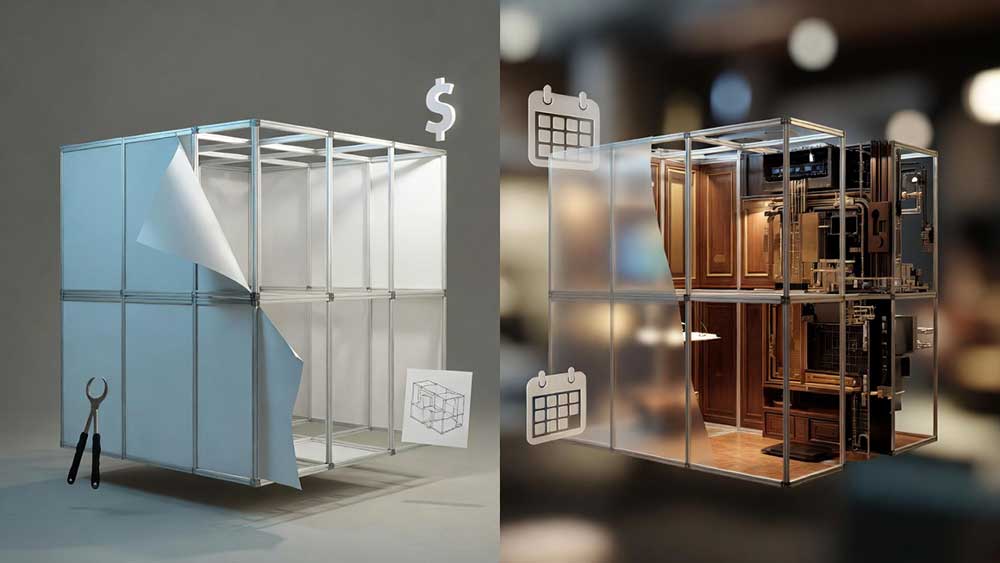
The answer nobody gives you is this: the “right” booth depends entirely on questions most exhibitors never think to ask before they’ve already spent the money.
Every year, thousands of companies walk onto the trade show floor with either a rented modular system that looks like every other booth in the hall, or a custom-built structure that nearly broke their logistics budget before a single lead was captured. Both camps have horror stories. Both camps have wins. And the booths that consistently perform? They’re almost never the result of picking a format—they’re the result of picking the right format for a very specific situation.
Modular is faster, cheaper upfront, and more flexible. Custom is more impactful, more brand-accurate, and more expensive to own and operate. But here’s what most people miss:
- Modular booths almost always cost more than exhibitors expect once you factor in recurring rental fees across multiple shows.
- Custom booths almost always underperform when companies don’t have the internal logistics support to manage them.
- The “best” option for your first show is almost never the best option for your fifth.
Let’s get into it properly.
The Modular Myth (And Why It Sells So Well)
Walk into any trade show exhibit house and the pitch for modular is seductive. Quick setup. No custom crating. Flexible configurations. And yes—all of that is true. Modular systems, particularly the modern fabric-and-frame systems from suppliers like Nomadic, Nimlok, or the pop-up tension fabric displays that dominate smaller footprints, genuinely deliver on those promises at the entry level.
The problem isn’t the pitch. The problem is that exhibitors treat “modular” as a permanent solution rather than a strategic tool.
Here’s what happens in practice: a company starts with a 10×10 modular rental for their first two or three shows. They like the simplicity. They upgrade to a 10×20. They add a hanging sign. They want a custom counter with their brand color. Then a meeting room. And suddenly they’re paying $8,000–$15,000 per show in rental fees for a system that, if purchased outright, would have paid for itself after the third event—and still doesn’t look quite right because modular systems have inherent aesthetic limitations baked into their structure.
The real-world reality of modular: it’s exceptional for companies doing one to three shows per year, testing new markets, or working with tight timelines. It’s a money pit for companies doing six-plus shows annually in the same configuration. That’s not an opinion—that’s a math problem, and it resolves cleanly every time.
One more thing most exhibitors never ask about modular: the hidden labor cost. Yes, these systems are designed for easier setup. But “easier” still means trained people, and if you’re relying on show-site labor (which you often are at larger venues), you’re paying union rates regardless of how simple the system claims to be. The savings in crating and shipping can quietly evaporate.
Custom Booths: The Performance Promise (And the Reality Check)
There’s a version of the custom booth conversation that’s basically aspirational fiction. You’ll hear it from every high-end exhibit house: your custom booth is a brand experience. A physical manifestation of your identity. An immersive environment that stops traffic.
And sometimes—genuinely—that’s true. A well-executed custom booth in a 20×20 or larger footprint, designed by people who actually understand spatial storytelling and exhibitor psychology, can be a serious competitive advantage. Companies like Apple, Google, and the major automotive brands spend millions on trade show environments for a reason: presence commands attention in ways that a banner stand and a folding table never will.
But here’s the part that gets glossed over: custom booths are not just expensive to build. They’re expensive to own.
Crating alone for a large custom booth can run $3,000–$8,000 in shipping per show. Storage between events, typically $200–$600 per month depending on your city and the booth’s size. Refurbishment costs after two or three shows, because custom structures take beatings during transport and installation. Graphics updates every 12–18 months to keep messaging current. And if your company’s branding shifts—new logo, new color palette, new product focus—a custom booth can become a sunk cost embarrassingly fast.
Based on analysis across dozens of exhibitor accounts, the companies that get the most value from custom booths share a few things in common: they have a dedicated exhibit manager or marketing operations person who owns the logistics, they exhibit at five or more shows per year (usually in the same configuration), and they’ve been doing trade shows long enough to know exactly what they need from a space. For everyone else, custom is often more aspiration than strategy.
The Decision Framework Nobody Hands You
So how do you actually choose? Here’s a simplified decision matrix that cuts through the noise:
Go modular when:
- You’re exhibiting fewer than four times per year
- Your booth configuration changes show-to-show (different footprints, different audiences)
- You’re a first-time exhibitor still learning what works
- Your budget is under $25,000 total for the year in exhibit spend
- Speed to market matters more than brand differentiation right now
Go custom when:
- You’re exhibiting five or more times per year in a consistent configuration
- Brand differentiation is a core part of your trade show strategy, not just a nice-to-have
- You have—or can hire—someone to manage the logistics
- Your total annual exhibit budget exceeds $50,000
- You’ve done at least two shows with a modular setup and know exactly what you’d do differently
The hybrid middle ground (which is increasingly where smart exhibitors land): a custom-designed structure built on a modular or semi-custom system. Companies like Exhibitline, Skyline, and others offer engineered systems that behave like custom builds but break down and store like modular. The aesthetic ceiling is lower than true custom, but the operational flexibility is dramatically higher. For mid-market exhibitors doing four to eight shows per year, this is often the most intelligent spend.
What the Floor Teaches You (That No Spec Sheet Does)
There’s a specific piece of knowledge you only get from actually standing in a 10×10 modular setup next to a competitor’s gorgeous custom island—and that’s the visceral understanding of what “booth presence” actually means in context.
On paper, a well-configured modular booth with strong graphics and good lighting can hold its own. On the floor, at a major industry event, with 20,000 people walking past in two days, the difference in how people perceive and approach spaces is real and measurable. Attendees are drawn to dimension, texture, and environmental depth. A flat tension fabric wall is intellectually understood as your brand. A custom structure with varied planes, integrated technology, and thoughtful lighting is experienced as your brand. That’s not the same thing.
This doesn’t mean custom is always worth it. It means the decision should be made with honest eyes open about what you’re trading off.
One thing almost universally underestimated: lighting. Whether you’re in a modular or custom booth, proper lighting—not the default overhead fluorescents the venue provides—is one of the highest-ROI investments in the trade show world. A $1,500–$3,000 lighting package transforms either booth type. It’s the one place where a modular booth can punch significantly above its weight class.
The Costs Nobody Puts in the Proposal
Let’s talk about the full picture, because what you see in a booth vendor’s proposal is almost never the full picture.
For a modular rental at a mid-size show, the actual cost breakdown typically looks like this:
- Rental fee: $3,000–$8,000
- Installation/dismantle (I&D): $1,500–$4,000
- Drayage (moving from dock to show floor): $800–$2,500
- Electrical: $400–$1,200
- Furniture and accessories: $500–$1,500
- Graphics (if not included): $500–$2,000
- Real total: $6,700–$19,200
For a custom booth purchase, the first-show cost is always the highest, but the amortization changes the math:
- Design and fabrication: $25,000–$150,000+
- Crating (one-time): $3,000–$8,000
- First-show shipping: $2,000–$6,000
- I&D: $2,000–$8,000
- Storage (annual): $2,400–$7,200
- Year one total: $34,400–$179,200
Divide that custom booth across six shows per year for three years and suddenly the per-show math gets far more interesting. That’s the calculation most people do after they’ve committed, not before.
The Evolution Happening Right Now
The modular vs. custom debate is actually being reshaped by two forces that didn’t exist in meaningful form five years ago: advances in digital fabrication and the normalization of experiential technology.
Digital fabrication—CNC routing, large-format 3D printing, precision laser cutting—has brought the cost of custom fabrication down meaningfully, especially for smaller components. An exhibitor who would have paid $40,000 for a custom structure in 2018 can sometimes achieve comparable visual impact for $28,000–$32,000 today.
Meanwhile, LED walls, touch-screen integration, and interactive digital elements have become expected rather than exceptional at most B2B trade shows. This matters because it changes the calculus on modular: a well-specified modular booth with strong AV integration and interactive technology can create a more compelling attendee experience than a static custom structure without any digital layer. The experience gap between modular and custom is narrowing—not because modular has gotten better at structure, but because technology has become the experiential differentiator that used to be structure’s job.
The honest contractor’s take: in 2025 and beyond, the companies winning on the trade show floor are thinking less about “modular vs. custom” and more about “what is this space supposed to accomplish, and what’s the most efficient path to that outcome.” Sometimes that’s a $5,000 modular rental with a $3,000 AV package. Sometimes that’s a $80,000 custom build. The format is a vehicle, not the destination.
What You Should Actually Walk Away With
The best trade show booth is the one that performs—measured in qualified leads, meaningful conversations, and brand impressions that last past the show floor. Neither format has a monopoly on performance.
If you’re early in your exhibiting journey, modular gives you the room to learn without locking in decisions you’ll regret. If you’re a seasoned exhibitor who knows your audience, knows your message, and knows your logistics capacity, custom is likely underused in your arsenal.
The one question worth sitting with: What does success actually look like at this specific show? Not “what booth looks impressive?” Not “what can we afford?” But what outcome justifies the spend—and what format best serves that outcome given your real-world operational constraints.
Answer that honestly, and the modular vs. custom question basically answers itself.
This analysis draws on industry pricing benchmarks from EXHIBITOR Magazine, the Trade Show Executive industry surveys, and direct exhibit house cost structures. Cost ranges reflect U.S. market conditions as of 2024–2025 and vary significantly by show location, venue union requirements, and booth complexity.