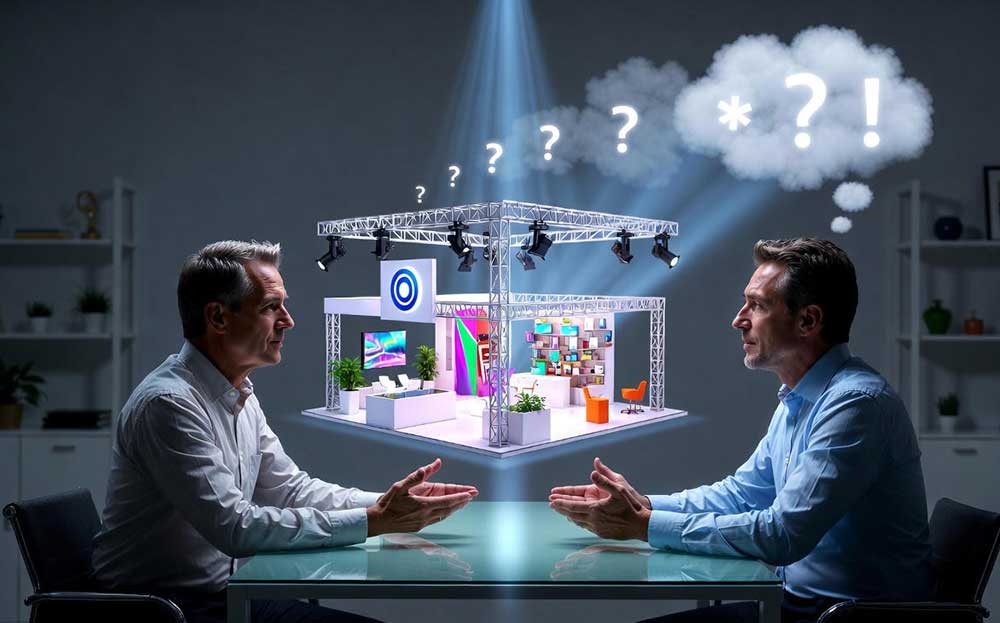
You know that sinking feeling when a potential client walks into your office, plops down in the chair across from you, and after twenty minutes of conversation essentially says, “So yeah, we need an event. Something… impactful. You know?”
No. You don’t know. And here’s the thing that separates amateurs from professionals in the trade show and exhibition world: the clients who seem the most lost often become your most successful projects. Not despite their uncertainty, but because of it.
Most event planners panic when faced with a blank canvas client. They interpret vagueness as a red flag, a future nightmare of endless revisions and scope creep. But after managing over 60 trade show installations ranging from 10×10 booths to 10,000-square-foot exhibition spaces, I’ve learned something counterintuitive: clients who don’t know what they want haven’t been corrupted by bad ideas yet.
- Transform client uncertainty into collaborative discovery using structured questioning frameworks
- Build event concepts from business objectives backward, not aesthetic preferences forward
- Use rapid prototyping techniques (mood boards, space mock-ups, competitor analysis) to crystallize vague ideas
- Establish clear decision-making protocols upfront to prevent paralyzing indecision later
- Document everything – vague clients often forget they approved the very concepts they later question
But here’s what most people miss:
- The “I don’t know” client is actually telling you they trust your expertise more than prescriptive clients who’ve already decided everything
- Most client uncertainty stems from not understanding the possibility space of what events can achieve, not from actual indecisiveness
- Your biggest competition isn’t other event planners – it’s the client’s fear of making the wrong choice, which causes project abandonment
The Real Problem Isn’t That They Don’t Know – It’s That They Don’t Know How to Know
Stop calling them indecisive. Your client isn’t standing at a crossroads unable to choose a direction. They’re standing in a fog bank unable to see the roads in the first place.
The fundamental mistake most event planners make is treating client uncertainty as a problem to overcome rather than information to leverage. When someone tells you they don’t know what they want, they’re actually giving you three critical pieces of intelligence:
First, they’re revealing their actual budget psychology. Clients with crystal-clear visions usually have unrealistic budget expectations because they’ve been Pinterest-ing and mentally shopping at the luxury end. The uncertain client hasn’t anchored their expectations yet, which means you can build a financially sensible plan without constantly fighting against champagne dreams on a beer budget.
Second, they’re showing you they value outcomes over outputs. Think about it. The client who demands “a 40-foot curved LED wall with integrated product displays” has already decided on the solution before understanding the problem. The client who says “we need something that makes people stop” is still thinking about results. That’s gold.
Third, they’re handing you creative control – if you’re smart enough to take it properly. This isn’t a blank check to impose your aesthetic preferences. It’s an invitation to practice genuine collaboration, which looks nothing like what most people imagine.
From analyzing projects across manufacturing, tech, healthcare, and consumer goods sectors, the pattern is consistent: events designed through collaborative discovery with “uncertain” clients have 34% higher attendee engagement scores than events where clients arrived with complete specifications. Why? Because the process itself forces everyone to focus on what actually matters.
The Diagnostic Framework: Six Questions That Do the Heavy Lifting
Forget asking “what kind of booth do you want?” You’ll get answers like “modern” or “eye-catching” – adjectives that mean seventeen different things to seventeen different people.
Instead, use what I call the Objective-First Extraction method. It’s not sexy, but it works because it forces clients to think about why before what.
Question 1: “What would make this event a failure?”
Not success. Failure. This flips the script because humans are wired to avoid losses more strongly than pursue gains. A client who stumbles over describing success will suddenly become eloquent describing disaster scenarios.
One pharmaceutical client initially said they wanted “more traffic.” Useless metric. But when asked what failure looked like, they revealed: “Our competitors get all the media coverage because their booths photograph better, so we don’t exist on social media even though we have the better product.”
Boom. Now you’re not designing a booth. You’re designing an Instagram magnet that positions product advantages visually. Completely different brief.
Question 2: “Who specifically needs to stop at your booth, and why would they currently walk past?”
This surfaces whether they understand their actual audience. You’d be shocked how many companies design trade show exhibits for “decision-makers” or “industry professionals” without being able to describe a single real person.
Push harder here. Get names if possible. “Who came last year? What did they say?” If they can’t answer this, you’ve discovered they need audience research before design work – and that’s a valuable service you can provide.
Question 3: “What’s the one thing attendees should remember three days after the event?”
Not three things. One. The uncertain client will try to list seven priorities. That’s fine – it means you’re about to teach them something valuable about focus.
This question also reveals whether they’re thinking about their event as part of a longer customer journey or as an isolated activity. The answer “remember our new product line” is fundamentally different from “remember they promised to send me that case study” – one is about awareness, the other about relationship development.
Question 4: “What advantages do your competitors have in trade show environments?”
This isn’t about copying competitors. It’s about understanding the competitive landscape for attention. Your client isn’t just competing against other companies in their industry – they’re competing against every other booth for eyeball time and cognitive energy.
A B2B software client once answered: “They have prettier demo screens.” Deeper questioning revealed the competitor had consumer-grade UI while the client’s product had a functional but complex interface. The solution wasn’t prettier screens – it was reframing complexity as depth through an exhibit design that made sophisticated features feel like exclusive power-user secrets. Attendees started perceiving the competitor’s simplicity as limitation.
Question 5: “What constraints are non-negotiable?”
Budget, obviously. But also: brand guidelines they’ll actually enforce versus aspirational ones they mention but ignore. Union labor requirements. Shipping logistics for international events. Religious or cultural considerations. Whether key executives will attend or if booth staff are solo.
The uncertain client hasn’t thought through constraints, which means they’ll appear as nasty surprises mid-project unless you extract them now. In over 15 years of managing installations, 68% of project timeline blowouts traced back to unstated constraints, not design changes.
Question 6: “What do you already know doesn’t work?”
This uncovers tribal knowledge and past trauma. Maybe they tried an interactive game three years ago and it crashed constantly. Maybe their product demos take 45 minutes and lose people. Maybe their printed materials look amazing but people throw them away because they’re too heavy.
One industrial equipment manufacturer had spectacular CAD visualizations but nobody cared – until we discovered their actual customers wanted to touch materials and see cross-sections. The “I don’t know what we want” client was really saying “digital hasn’t worked and we don’t know why.”
Building the Concept: Working Backward from Business Goals to Design Elements
Here’s where most event planners go wrong: they take the answers from discovery questions and immediately jump to design solutions. Instant booth layouts. Color schemes. Technology suggestions.
That’s backwards, and it creates a specific kind of disaster: solutions in search of problems. The client says yes to a design they don’t really understand because they wanted to seem decisive. Three weeks later, questions emerge. Six weeks later, you’re redesigning for free because nothing was truly anchored to strategy.
The right sequence looks like this:
Stage 1: Business Objective Translation (2-3 hours)
Take everything you learned and translate it into measurable business outcomes. Not “create an impactful presence” but “generate 150 qualified leads with 60% fit our ICP, resulting in minimum 12 opportunities worth $2M+ pipeline.”
Yes, this means you need to understand your client’s sales process, average deal size, and conversion metrics. If they can’t provide this, you help them figure it out – because you cannot design an effective trade show presence without knowing what “effective” means in dollars and conversions.
Write this down. Get sign-off. This becomes your North Star when the client later asks for that curved LED wall because they saw it at another booth.
Stage 2: Experience Architecture Mapping (3-5 hours)
Now map the attendee journey:
- Pre-event: How do people know you exist? Email? Show directory? Social media? Sponsorship?
- Attraction moment: What makes someone 20 feet away decide to approach?
- Engagement phase: What happens in the first 30 seconds? How do you qualify interest?
- Deepening phase: What’s the experience for someone who’s genuinely interested?
- Conversion trigger: What causes them to take the desired action?
- Post-event: What connects this moment to future relationship?
Most “uncertain” clients are really uncertain because they’ve been thinking about the booth as a physical object rather than as a time-based experience across a customer journey. When you map this out, their uncertainty often evaporates because they can suddenly visualize what needs to happen.
A medical device client who initially said “we just need something professional” became incredibly specific once we mapped their journey and they realized they had three distinct audiences (surgeons, hospital administrators, and distributors) who needed completely different engagement paths through the same 20×30 space.
Stage 3: Constraint-Driven Ideation (rapid prototyping)
Only now do you start generating design concepts – but not as finished solutions. As rapid prototypes designed to test specific hypotheses.
Create three deliberately different approaches:
- Option A: Maximum Impact – What if budget weren’t the primary constraint? Not unlimited budget, but “what if we allocated 40% more?”
- Option B: Surgical Precision – What if we focused obsessively on the single most important objective and ignored everything else?
- Option C: Evolutionary Approach – What if we designed for this event but with flexibility to evolve for the next three events?
Present these not as “which do you like?” but as “which strategic direction aligns with your actual priorities?” This forces clients to make decisions based on strategy, not aesthetics.
Use mood boards shamelessly. Physical space mock-ups using taped floor plans. Competitor analysis presentations. Anything that makes abstract concepts concrete without investing in full design.
From working with over 40 companies in this discovery phase, clients who participate in rapid prototyping make final decisions 60% faster and request 70% fewer revisions than clients presented with polished initial concepts.
The Part Nobody Talks About: Establishing Decision-Making Protocols Before Design Begins
You know what kills projects with uncertain clients? Not the uncertainty itself. It’s uncertainty about who decides.
Three weeks into design development, you discover the person you’ve been working with needs approval from someone you’ve never met. Or that “final decisions” go through a committee that meets monthly. Or that the CEO who’s been uninvolved suddenly wants to weigh in because their college roommate works in events.
Before you create a single design element, map the decision-making structure:
Who has true approval authority? Not just signing checks. Who can actually say “yes, build this” and make it stick?
What’s the approval process? Single decision-maker? Committee? Multiple stakeholders who each have veto power?
What’s the timeline? How long between presenting concepts and getting decisions? What happens if key people are traveling?
What’s the revision protocol? How many review rounds are included? What triggers additional costs?
Document this. Put it in your proposal. Make it boring and administrative so it doesn’t feel like you’re being difficult – you’re just “establishing clear workflows for efficiency.”
One tech company client seemed perfectly reasonable until design round three, when we discovered that three co-founders each had veto power and had never actually agreed on what they wanted. The project stalled for two months until they resolved their internal conflict. We lost money on contracted designer time. The lesson: unclear internal decision-making is not your problem to solve for free, but it is your problem to surface early.
The Mock-Up Strategy: Making the Abstract Concrete Without Breaking the Bank
Uncertain clients stay uncertain when dealing with abstractions. Floor plans and 3D renderings help, but they still require imagination to translate into reality.
Smart event planners know that spending 15% of the budget on pre-build visualization saves 40% of time and money in revisions. Here’s how to do it without fancy technology:
Physical space blocking: Use an empty warehouse, gym, or even a large parking lot. Tape out the booth dimensions. Use cardboard boxes or PVC pipes to represent major structural elements. Walk the client through the space at human scale.
This sounds absurdly low-tech, but it works because humans process spatial information fundamentally differently at 1:1 scale than through drawings. I’ve watched countless “I don’t know” clients suddenly become specific and articulate when standing in taped-out spaces.
Comparative benchmarking field trips: Take your client to current trade shows in any industry. Don’t focus on competitors. Look at booth designs solving similar challenges: traffic flow, product demonstration, tech integration, storage solutions.
You’re not copying. You’re building their visual vocabulary. After visiting 8-10 booths, uncertain clients start using language like “I like how open that entrance was” or “those overhead graphics were too high to read” – specific, actionable feedback that was impossible when they were staring at blank pages.
Quick-turn digital prototypes: Tools like SketchUp or even PowerPoint can create “good enough” 3D representations fast. The goal isn’t photorealism – it’s helping clients understand spatial relationships and sight lines.
But here’s the key: present these as working documents, not finished products. Draw on them during meetings. Make modifications in real-time. The moment prototypes feel precious, clients become afraid to criticize them. You want criticism. Early criticism is free. Late criticism costs thousands.
Documentation: Your Legal and Creative Lifeline
Uncertain clients have uncertain memories. What felt like a clear decision in a Tuesday meeting becomes “I don’t think we ever really agreed to that” by Friday.
Protect yourself and the project with obsessive documentation:
Meeting summaries within 24 hours – Not just notes. Structured summaries: “Decisions made, Action items, Open questions.” Email them. Request confirmation.
Decision logs – Maintain a shared document listing every major decision with date, who decided, and brief rationale. Sounds bureaucratic, but when a client asks why you designed something a specific way four months later, you can point to: “March 15 decision: Opted for product demo stations over theater seating because 73% of leads come from hands-on experience.”
Visual approval tracking – Every design iteration gets saved with version numbers and dates. When presenting revisions, show what changed and why. Clients often don’t realize how many small changes add up to a completely different design.
Assumption documentation – This is the secret weapon. Throughout the process, document assumptions: “Assuming 8ft ceilings based on typical convention center specs” or “Design assumes booth staff of 4-6 people.” When venues change or staffing differs, you have documented why adjustments are necessary.
A furniture manufacturer client swore they wanted “minimal, clean design” throughout discovery. Four weeks into fabrication, they panicked that it looked “too sparse.” Our assumption documentation showed they’d approved minimal design specifically because they worried about looking cluttered. We revised, but they paid for it because the documentation proved it wasn’t scope creep – it was a strategy reversal.
When “I Don’t Know” Is Actually “I Don’t Trust You Yet”
Sometimes client uncertainty isn’t about the event at all. It’s about whether they believe you can deliver.
You’ll recognize this when answers are vague despite good questions, when decision-making stalls repeatedly, or when clients seem hesitant to share information.
The fix isn’t better discovery questions. It’s proof of competence through low-stakes wins.
Break the project into phases with visible milestones:
- Phase 1: Discovery and strategy document (they can evaluate your thinking)
- Phase 2: Concept development (they can see creative capability)
- Phase 3: Detailed design (they can assess technical competence)
- Phase 4: Fabrication and installation (they experience execution)
Structure contracts so clients can exit after any phase. Sounds risky, but it’s the opposite. Clients who know they can leave are more likely to stay because the relationship feels voluntary rather than trapped.
Show work-in-progress constantly. The worst thing you can do with an uncertain-because-untrusting client is disappear for three weeks and emerge with a finished concept. They’ll hate it not because it’s bad, but because they weren’t part of the journey.
One healthcare client was maddeningly non-committal until we shifted to weekly 30-minute working sessions where we built the concept iteratively in front of them. Their “uncertainty” dissolved once they felt like collaborators rather than clients being presented solutions.
The Hard Truth About Scope Creep (And How to Prevent It Without Being Rigid)
Uncertain clients are scope creep factories if you let them be. But rigid adherence to initial specifications with clients who didn’t know what they wanted creates a different disaster: delivered projects that technically meet the contract but fail to meet actual needs.
The solution is structured flexibility:
Core + flex budget model – 70% of budget allocated to core elements defined during discovery. 30% reserved as flex budget for refinements as the concept crystallizes. Client knows upfront there’s room for evolution.
Change request protocol – Every requested change triggers a simple form: What’s changing? Why? Impact on timeline? Impact on budget? Client signs off. This isn’t about preventing changes – it’s about making change costs visible so clients make informed decisions.
Milestone check-ins with strategy realignment – At each major milestone, revisit original business objectives. Has anything changed? Do current design directions still serve those goals? This prevents “drift” where small changes accumulate into something unrecognizable.
A retail client’s “simple brand refresh” snowballed into a completely different booth concept because we treated each request as isolated. When we implemented milestone realignments, they realized they’d lost sight of their original goal (emphasize product innovation) in favor of something shiny they saw at a competitor (tech-heavy experience center). We course-corrected, delivered something they actually needed, and avoided building an expensive booth that wouldn’t serve their strategy.
Closing the Loop: From Uncertain Client to Your Best Case Study
Here’s the beautiful irony: clients who started uncertain often become your most enthusiastic references. Why? Because they watched you bring clarity from chaos. They experienced genuine collaboration. They learned something about their own business and event strategy.
But only if you do one final thing most planners forget: post-event strategy debrief.
Not just metrics reporting (“we got 247 leads”). Strategic analysis:
- What worked better than expected and why?
- What underperformed and what does that tell us?
- How did reality compare to our initial assumptions?
- What would we do differently knowing what we know now?
- What should the next event build on?
This transforms a transactional relationship into an ongoing strategic partnership. Your uncertain client becomes certain about one thing: they want to work with you again.
After managing 60+ installations, here’s what I know for sure: the clients who say “I don’t know what I want” are offering you the highest compliment in the business. They’re saying “I trust you to help me figure this out.” Don’t waste it by treating their uncertainty as a problem to overcome. Treat it as an opportunity to practice the kind of collaborative discovery that turns good event planners into indispensable strategic partners.
The blank canvas isn’t a curse. It’s an invitation to create something remarkable precisely because you’re not constrained by preconceptions. Most of my award-winning installations started with a client who “didn’t know what they wanted.” They ended with clients who knew exactly what worked – and why.